Invited Talk – Antimicrobial Applications of Metal Oxide Nanomaterials at International Conference

We are proud to share that Dr. Srinivasa Reddy, Professor & Head of the Department of Physics at Anurag University, has successfully delivered an Invited Talk at the International Conference on Emerging Trends in Science and Technology, organized by the Department of Physical Sciences at Little Flower Degree College Uppal, held from 28th to 31st July 2025 in Hyderabad.
Topic: “Antimicrobial Applications and Efficacy of Metal Oxide Nanomaterials.” His presentation highlighted advanced research on the antimicrobial properties of metal oxide nanomaterials, contributing to developments in nanotechnology and biomedical applications.
Anurag University takes immense pride in the achievements of its students, faculty, and research scholars. Every individual success is a reflection of the collective commitment to excellence, innovation, and meaningful contribution that defines the institution’s academic culture.

Written By
By AU Media Team
More Stories You Might Like
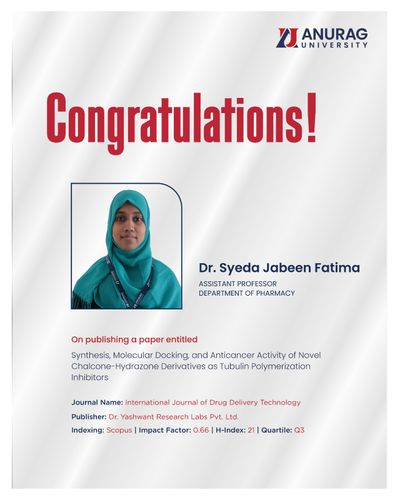
Exploring Novel Approaches to Cancer Treatment
Dr. Syeda Jabeen Fatima, Assistant Professor in the Department of Pharmacy at Anurag University, has published research on novel chalcone–hydrazone derivatives as tubulin polymerization inhibitors in the International Journal of Drug Delivery Technology, a Scopus-indexed Q3 journal.
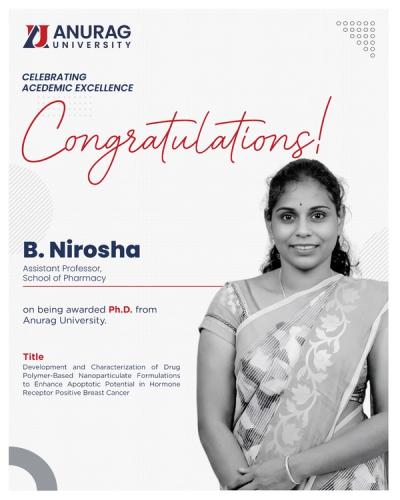
Advancing Research in Targeted Drug Formulations
B. Nirosha, Assistant Professor at the School of Pharmacy, Anurag University, has been awarded a Ph.D. for her research on polymer-based nanoparticulate drug formulations to enhance apoptotic potential in hormone receptor-positive breast cancer.
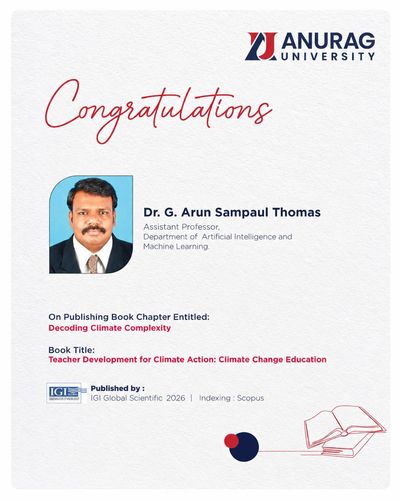
Contributing to Climate Action Through Research
Dr. G. Arun Sampul Thomas, Assistant Professor in the Department of Artificial Intelligence and Machine Learning at Anurag University, has published a book chapter titled “Decoding Climate Complexity” in Teacher Development for Climate Action: Climate Change Education, published by IGI Global Scientific in 2026 and indexed in Scopus.