
CSE Faculty and Students Publish Research on Hybrid Transformer-Domain and Machine Learning-Based System Identification
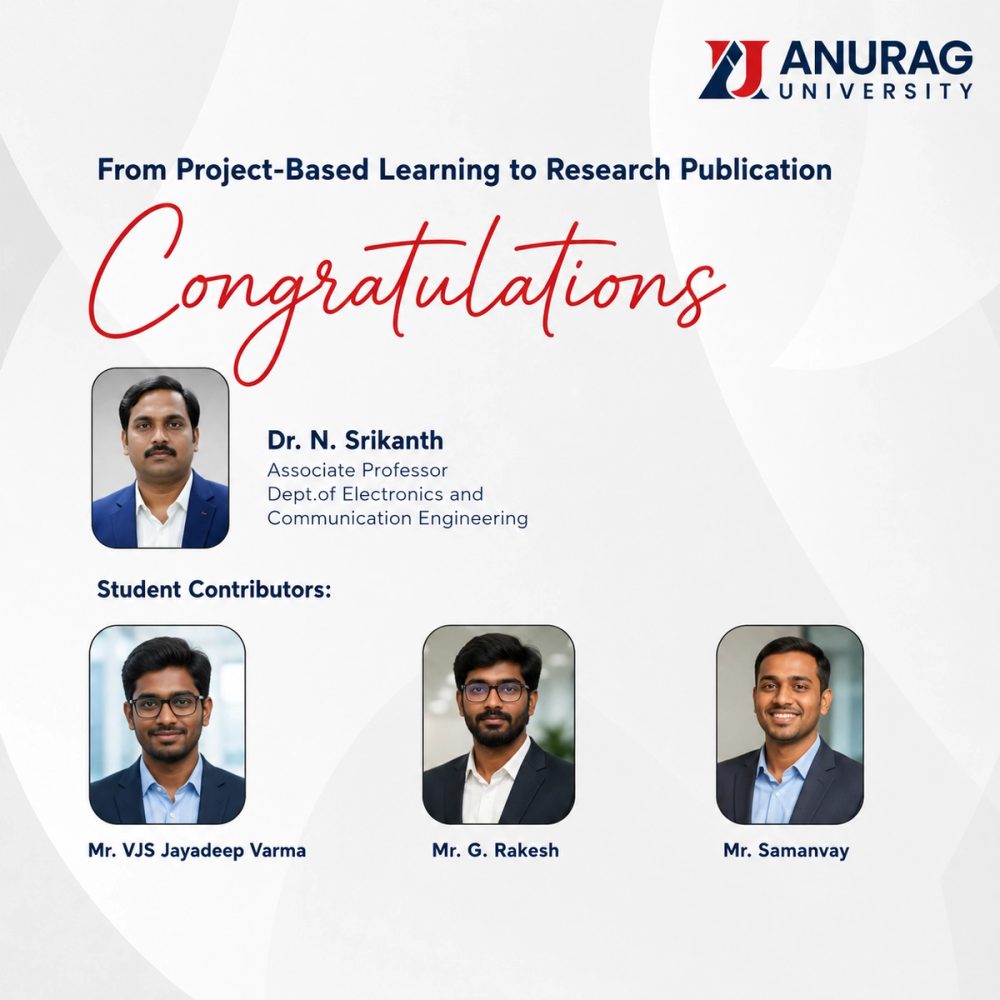
Dr. N. Srikanth, Associate Professor, Department of Electronics and Communication Engineering, Anurag University, along with student contributors Mr. VJS Jayadeep Varma, Mr. G. Rakesh, and Mr. Samanvay, has achieved a notable research publication milestone. Their research paper, titled “Hybrid Transform-Domain and Machine-Learning-Based System Identification for First- and Second-Order LTI Systems,” was presented at the 2026 International Conference on Emerging Trends in Information, Communication & Systems (ICETICS).
The research reflects the successful transition from project-based learning to academic research, bringing together transform-domain techniques and machine learning approaches for system identification. The collaboration between faculty and students highlights the value of experiential learning and research-oriented education in developing practical technical expertise.
This achievement demonstrates the commitment of Anurag University to fostering a strong culture of innovation, collaborative research, and student participation in academic platforms. The publication serves as an encouraging milestone for the faculty and student researchers and inspires continued exploration in emerging areas of engineering and technology.

Written By
By AU Media Team
More Stories You Might Like
MedRAG: Advancing AI-Powered Smart Healthcare
Dr. P. Raja Sekhar Reddy, Ms. K. Sarvani, and Mr. D. Vaman Ravi Prasad have published a Scopus Q2 research paper on a multimodal, privacy-preserving AI agent for proactive home health screening and smart triage.

Building Industry Skills Through Grad Guru Internship
Malreddy Harshitha, B.Tech AIML IV Year, has been selected for an internship at Grad Guru with a monthly stipend of ₹27,000.
Transformer-Based Framework for Heart Disease Prediction
Mr. K. Krishna, Assistant Professor, Department of Artificial Intelligence, has published a research article on a transformer-based framework for heart disease risk prediction with clinical interpretability and computational efficiency.