Why Are Anurag University’s Faculty Members Among the World’s Top 2% Scientists?
What does it take to become a scientist recognised among the world’s top 2%?
It takes more than publishing research papers. It requires years of curiosity, persistence, critical thinking and a commitment to advancing knowledge that can make a difference beyond the laboratory or classroom.
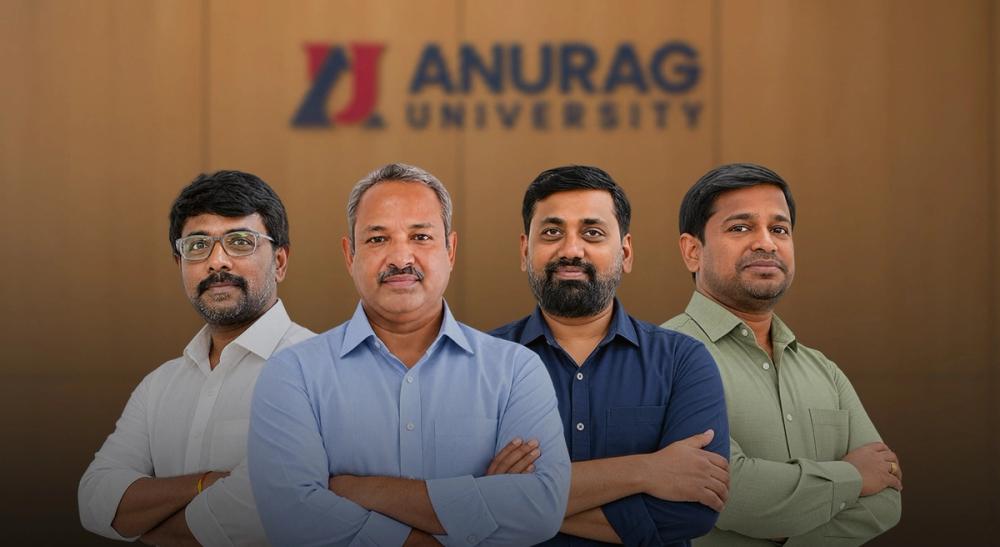
At Anurag University, four faculty members have earned this recognition for their contributions to research across computer science, mathematics and electrical engineering: Dr. K. Sudheer Reddy, Dean Academics & Planning; Dr. Y. Dharmendar Reddy and Dr. Mella Anil Kumar, Professors of Mathematics; and Dr. Srikanth Goud, Associate Professor of Electrical and Electronics Engineering.
The World’s Top 2% Scientists list, commonly known as the Stanford–Elsevier list, recognises researchers whose work meets defined citation-based selection criteria. Developed using data from Elsevier’s Scopus database, it considers indicators such as citations, the h-index, co-authorship and a composite citation score to assess research impact across scientific fields. With separate assessments for career-long contributions and single-year impact, the list offers a way to recognise researchers whose work has contributed to the wider scientific community.
For Anurag University, the inclusion of four faculty members highlights their continued contributions across computer science, mathematics and electrical engineering, and celebrates the dedication behind their research journeys.
Where Technology Meets Real-World Challenges
How can technology help us make better decisions, manage complex projects and address challenges that affect everyday life?
For Dr. K. Sudheer Reddy, whose research journey began in 2010, these questions have shaped an interdisciplinary approach to research. Alongside his responsibilities as Dean Academics & Planning at Anurag University, he continues to explore how computational methods can address practical challenges.
His research focuses on software engineering, particularly the integration of Artificial Intelligence with traditional Waterfall and Agile methodologies to improve resource planning and project management. His interests also extend to image-based approaches to breast cancer detection and AI-driven stock-market forecasting.
Although these applications belong to different domains, they share a common objective: exploring how technology can support more informed decisions and effective solutions.
His work reflects the growing potential of interdisciplinary research, where ideas from computing and AI can be applied to problems beyond their traditional boundaries.
Exploring the World Through Mathematics
What can mathematics reveal about fluid movement, heat transfer and the behaviour of complex physical systems?
For Dr. Y. Dharmendar Reddy and Dr. Mella Anil Kumar, Professors in the Department of Mathematics at Anurag University, these questions have guided years of research connecting mathematical theory with engineering applications.
With around 14 years of research experience, Dr. Y. Dharmendar Reddy has contributed more than 80 research publications and achieved an h-index of 28. His work explores fluid mechanics, heat and mass transfer, including the behaviour of electrically conducting fluids under magnetic fields. Through mathematical modelling and numerical methods, his research investigates the complex processes that govern these systems.
Looking ahead, his research interests extend to Artificial Intelligence, neural networks and biofluids, opening further avenues for interdisciplinary exploration.
Dr. Mella Anil Kumar, with approximately a decade of research experience, investigates fluid mechanics and heat and mass transfer. His research has potential applications in heat exchangers, thermal energy storage, cooling technologies, polymer sheets and fuel cells.
His contributions also extend to teaching, earning him the Anurag University Best Teacher Award for 2022–23, the Senior Educator and Scholar National Award in 2024, and the AQER Best Teacher Award in 2025.
His future research interests include nanofluids and enhanced cooling systems, areas that could contribute to the development of more effective thermal management solutions.
Together, their journeys demonstrate how mathematical research can move beyond equations on a page to improve our understanding of physical systems and inform engineering innovation.
The Dedication Behind Reliable Power Systems
Electricity powers everyday life, but ensuring that power systems remain stable, reliable and efficient requires continuous research.
Since 2019, Dr. Srikanth Goud, Associate Professor of Electrical and Electronics Engineering, has pursued research in power systems, power quality improvement, hybrid renewable energy systems and intelligent control.
His research contributions include more than 140 papers, and he has reviewed over 250 research articles, reflecting his engagement with both producing and evaluating scholarly work.
Yet, research recognition does not always arrive quickly. For Dr. Srikanth Goud, the moment of discovery came after a wait of nearly three years. During a late-night search, he eventually found his name on the list.
That moment captures an often-overlooked part of academic research: progress can be gradual, recognition can take time, and persistence remains essential even when the outcome is uncertain.
His journey highlights the commitment required to keep investigating, publishing and contributing to a field whose challenges continue to evolve.
What Connects These Different Journeys?
Their research questions may be different, but the values behind their work are remarkably similar: curiosity, persistence, continuous learning and a willingness to explore problems without easy answers.
At Anurag University, the achievements of these faculty members also highlight the role of research in an academic environment where teaching, mentorship and discovery complement one another.
Through faculty guidance, research projects and doctoral supervision, students have opportunities to connect classroom concepts with practical questions, explore unfamiliar areas and develop their own research interests. Learning from faculty members engaged in active research can also help students understand that meaningful discoveries often begin with a simple question and grow through experimentation, analysis and persistence.
The value of research, therefore, extends beyond individual publications, citations or professional recognition. It lies in the knowledge it creates, the questions it inspires and the possibilities it opens for future researchers.
Inspiring Tomorrow’s Researchers
The recognition of Dr. K. Sudheer Reddy, Dr. Y. Dharmendar Reddy, Dr. Mella Anil Kumar and Dr. Srikanth Goud celebrates their contributions to research across diverse scientific disciplines. More importantly, their journeys offer a reminder that academic excellence is built through consistent effort, curiosity and a willingness to keep learning.
At Anurag University, their achievements reinforce the importance of an academic culture that values both knowledge and the pursuit of new ideas.
For students considering a future in research, these journeys offer an encouraging starting point: ask questions, explore possibilities and remain open to where learning can lead.
Because tomorrow’s discoveries begin with the questions we ask today.
Explore Anurag University’s academic programmes and research opportunities to discover where your own journey could begin.

Building bright futuressince two decades